
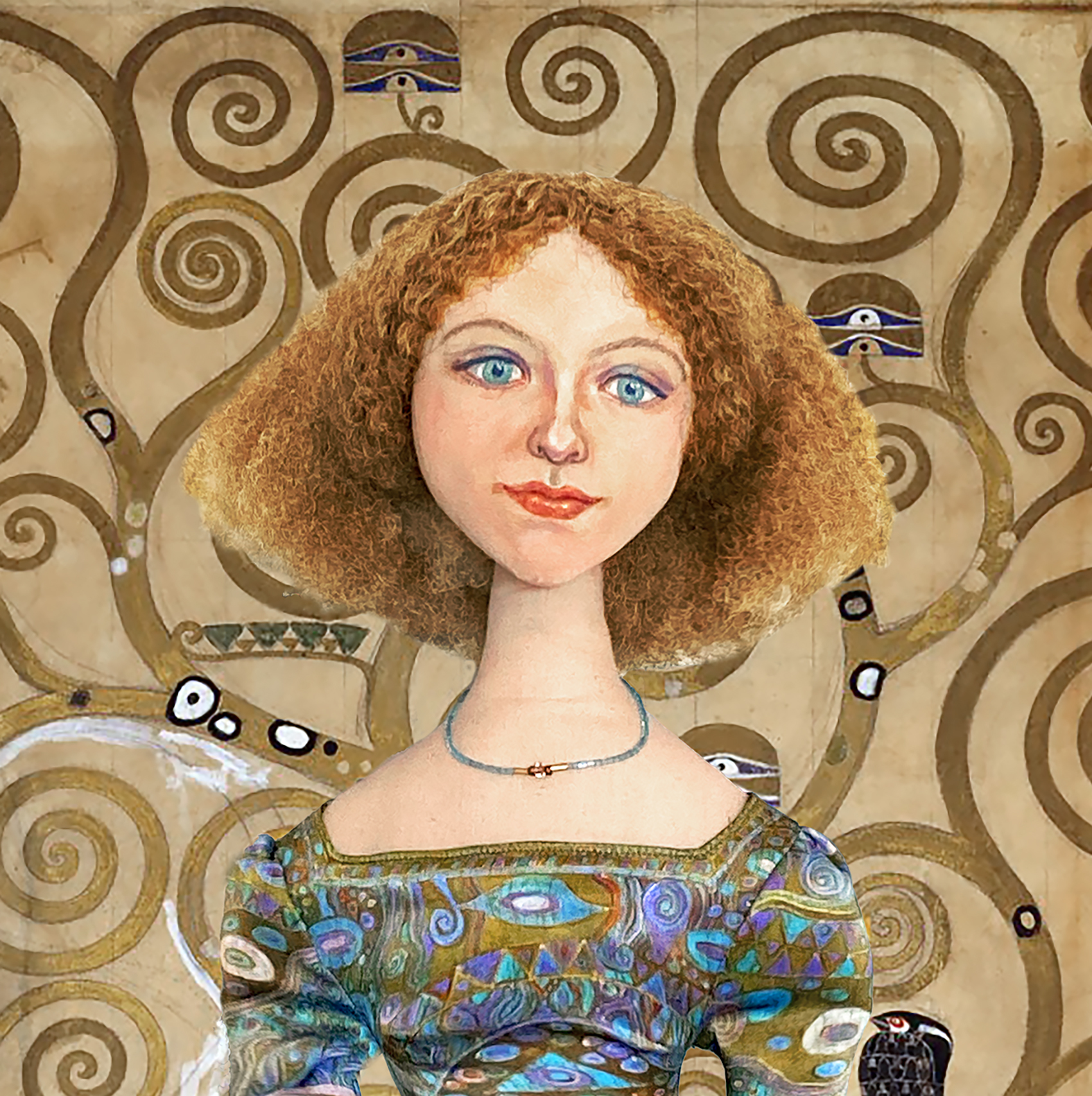
My muse creation of Emilie Flöge
Emilie Flöge is particularly fascinating because she was both muse and creator. I was drawn not only to the remarkable portrait Gustav Klimt created of her, but to the woman who existed beyond the frame. Her friendship with Klimt, her love of textiles and pattern, and her determination to establish herself professionally make her especially relevant to my own practice. There is something fitting about recreating her in cloth… bringing together the artist who painted her, the woman who designed clothes, and my own fascination with textiles and portraiture.
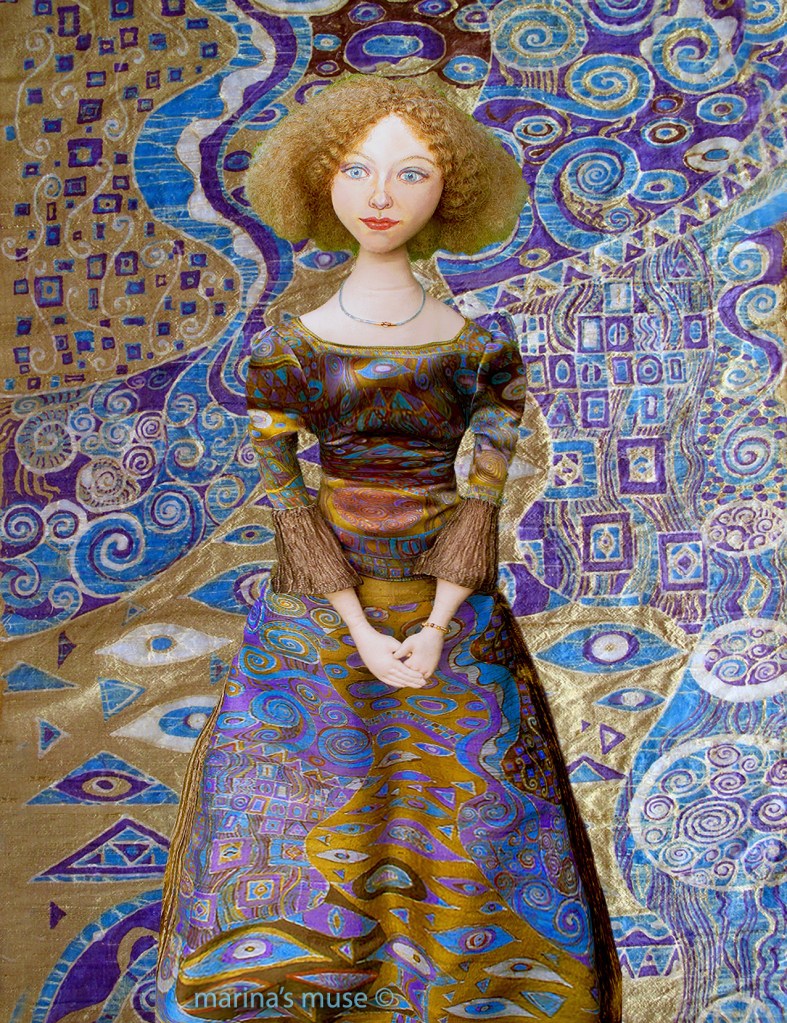
Emilie Flöge muse with batik silk fabric made by Marina Elphick.
Emilie The Muse
Emilie Flöge was much more than the beautiful woman who appears in Gustav Klimt’s celebrated portrait. She was an independent, creative and successful woman who played an important part in Vienna’s vibrant artistic and cultural life at the turn of the twentieth century. A fashion designer, couturier and businesswoman, she became one of the most distinctive figures of the Viennese fin de siècle, a period of extraordinary artistic experimentation and change.

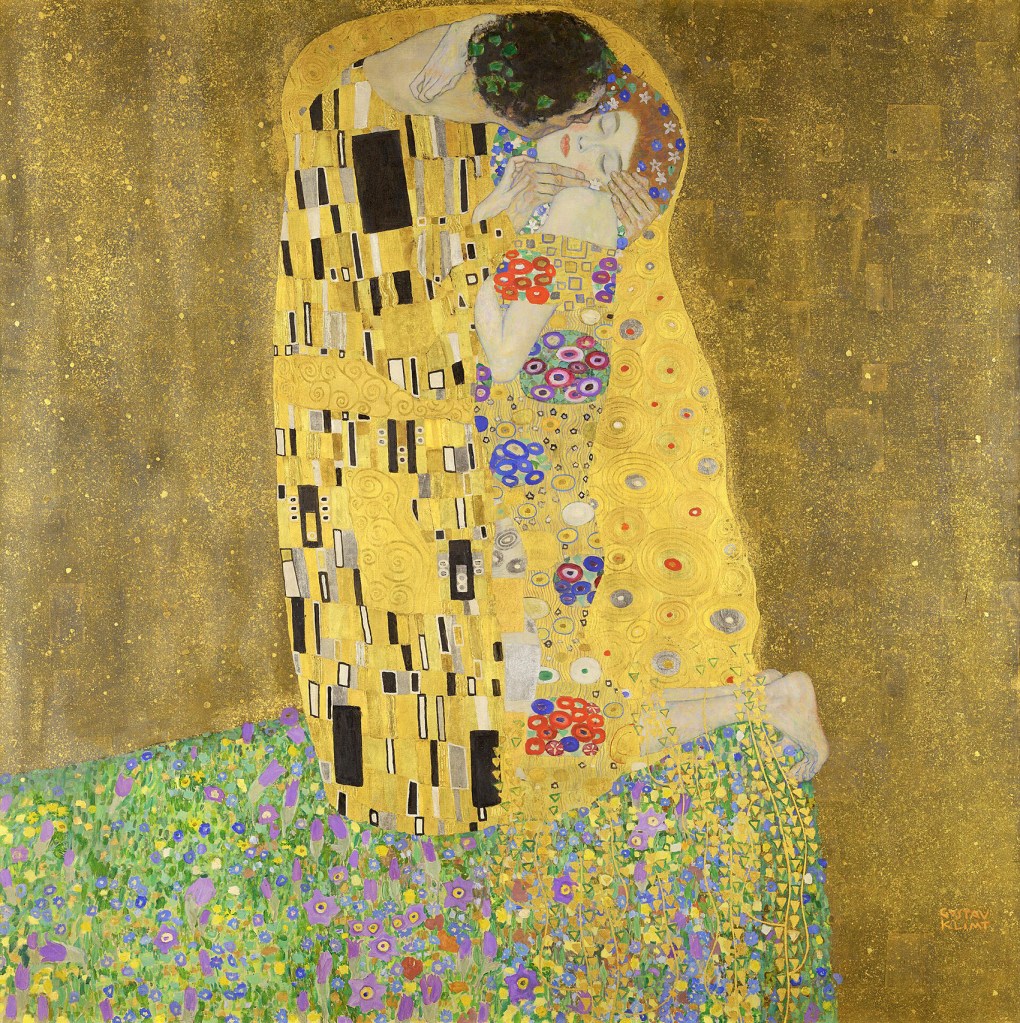
Emilie Flöge muse with, ‘Expectancy’ 1905 by Gustav Klimt. ‘The Kiss’, by Gustav Klimt 1907-1908, Oil and gold leaf on canvas. It is believed that Emilie modelled for Gustav Klimt’s ‘The Kiss.’
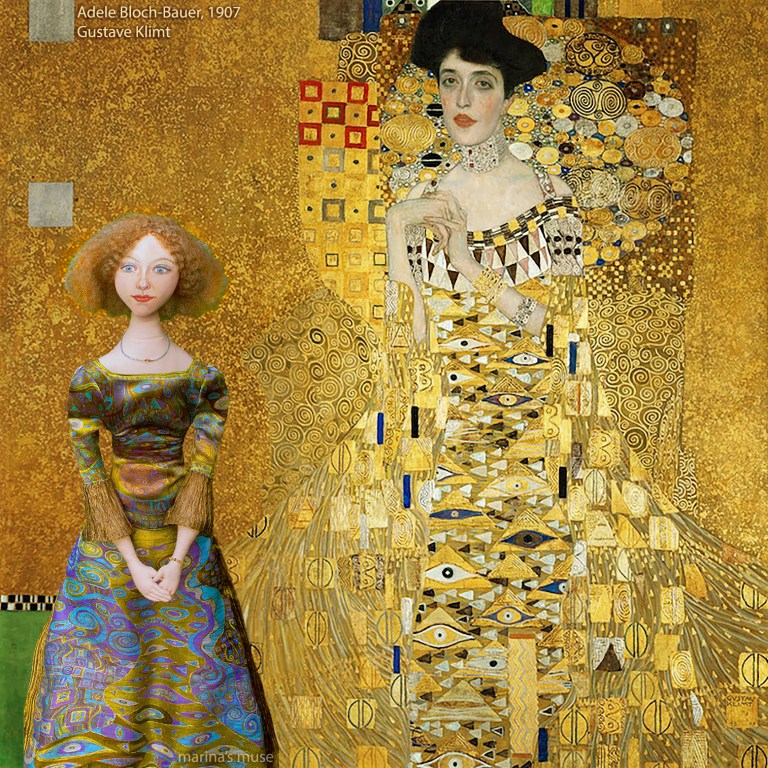
Emilie Flöge muse with the portrait of Adele Bloch-Bauer, by Gustav Klimt, 1907.
Emilie Flöge
Born in Vienna in 1874, Emilie was the daughter of Hermann Flöge, a prosperous craftsman and manufacturer of meerschaum pipes. She grew up with two sisters, Pauline and Helene and brother Hermann, in a family where enterprise and craftsmanship were part of everyday life. Emilie trained as a seamstress and began her working Emilie modelelife in the family’s dressmaking business. In 1899, she and her sister Pauline won a dressmaking competition, an early indication of the talent and ambition that would shape her future career.
Her connection with Gustav Klimt began through her family. In 1891, Emilie’s elder sister Helene married Klimt’s younger brother, Ernst. Helene was pregnant when Ernst died suddenly in 1892, aged only 28 and Gustav stepped in to assist the Flöge family and he became guardian to their young daughter. Through this family connection he became a frequent visitor to the Flöge household, Emilie was eighteen at the time.
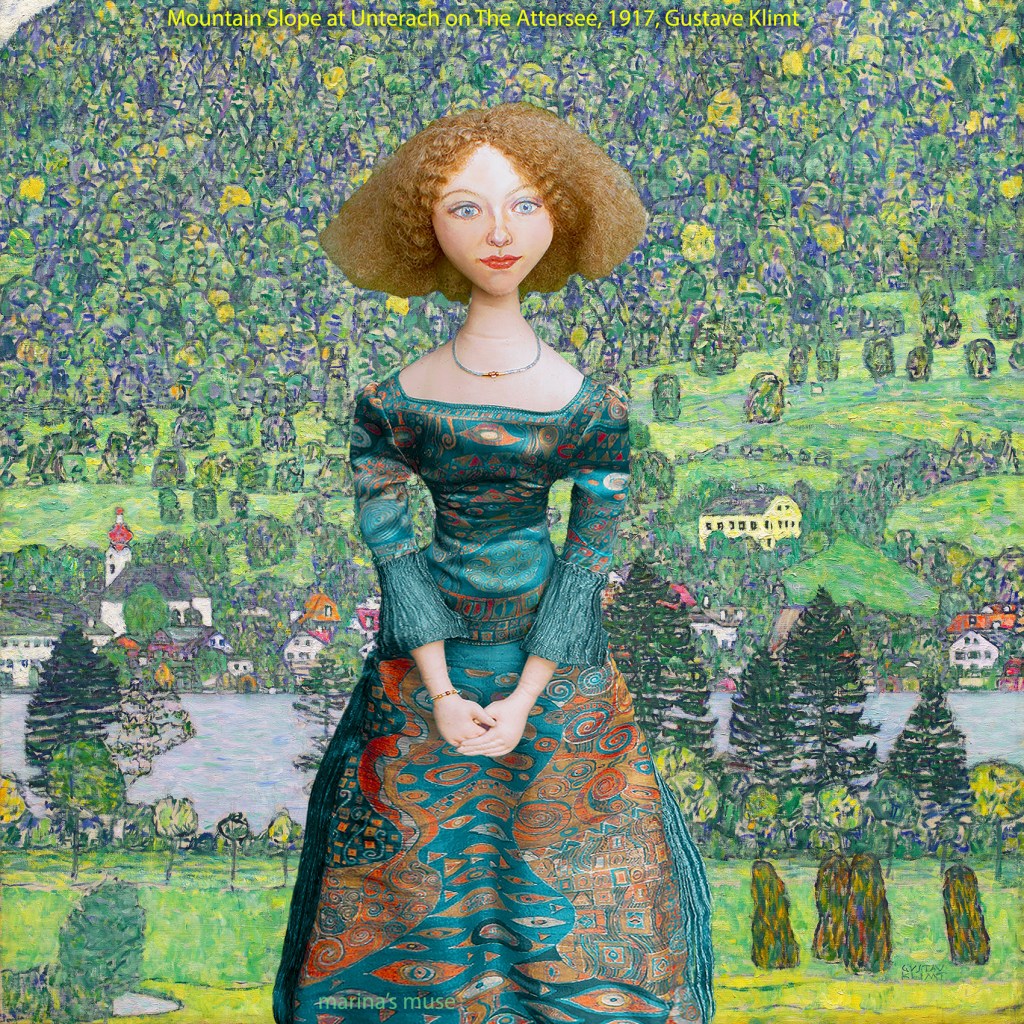
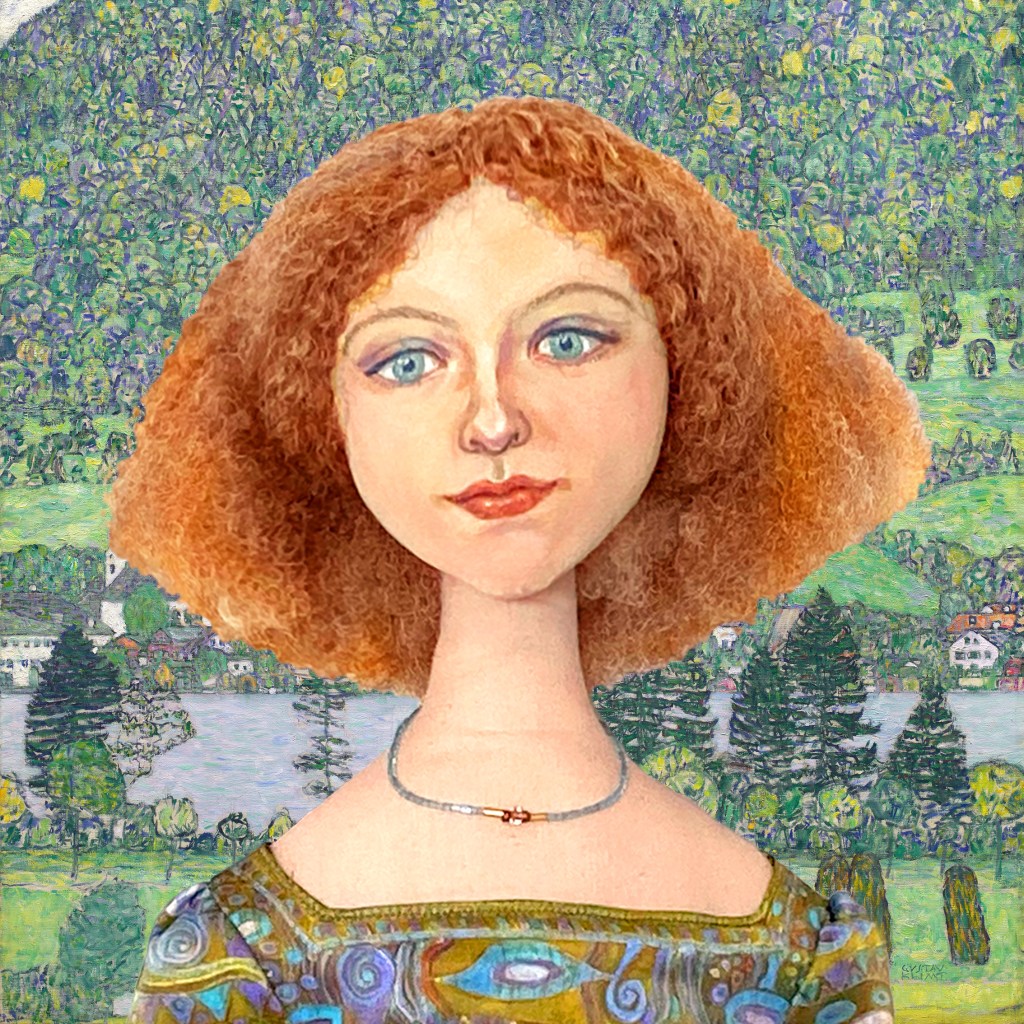
Emilie Flöge muse imagined at ‘Unterach on the Attersee’, in a painting by Gustav Klimt, 1917.
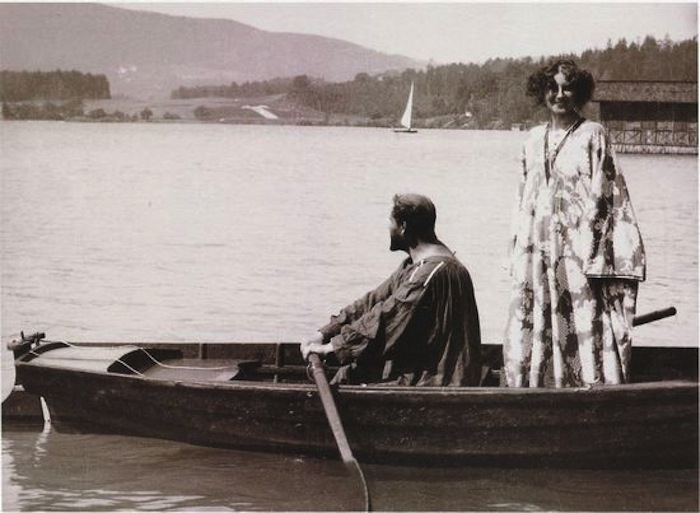
Over the following decades, the relationship between Emilie and Gustav developed into a deep and enduring friendship. They spent many summers with the Flöge family at Lake Attersee, where Klimt painted and Emilie became part of the close circle of people who surrounded him.
The exact nature of their relationship has remained a subject of speculation. They were certainly exceptionally close, but there is no clear evidence that they were lovers. What survives suggests a relationship built on affection, companionship and mutual respect, lasting for many years. Perhaps it is this uncertainty that has allowed their friendship to acquire such a romantic aura, but what seems most certain is the significance they held for one another.
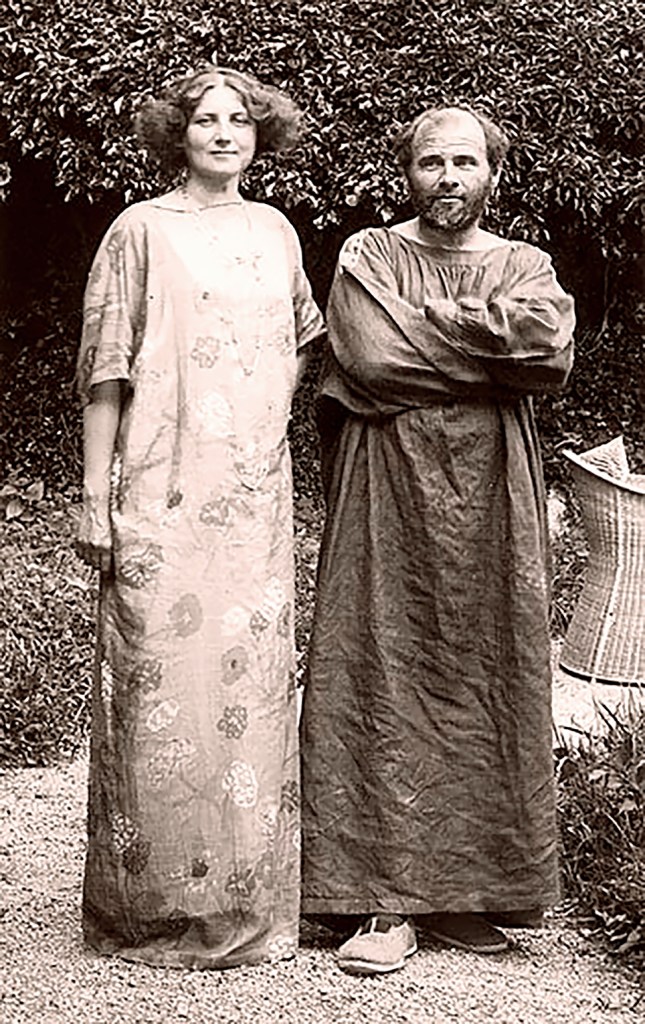
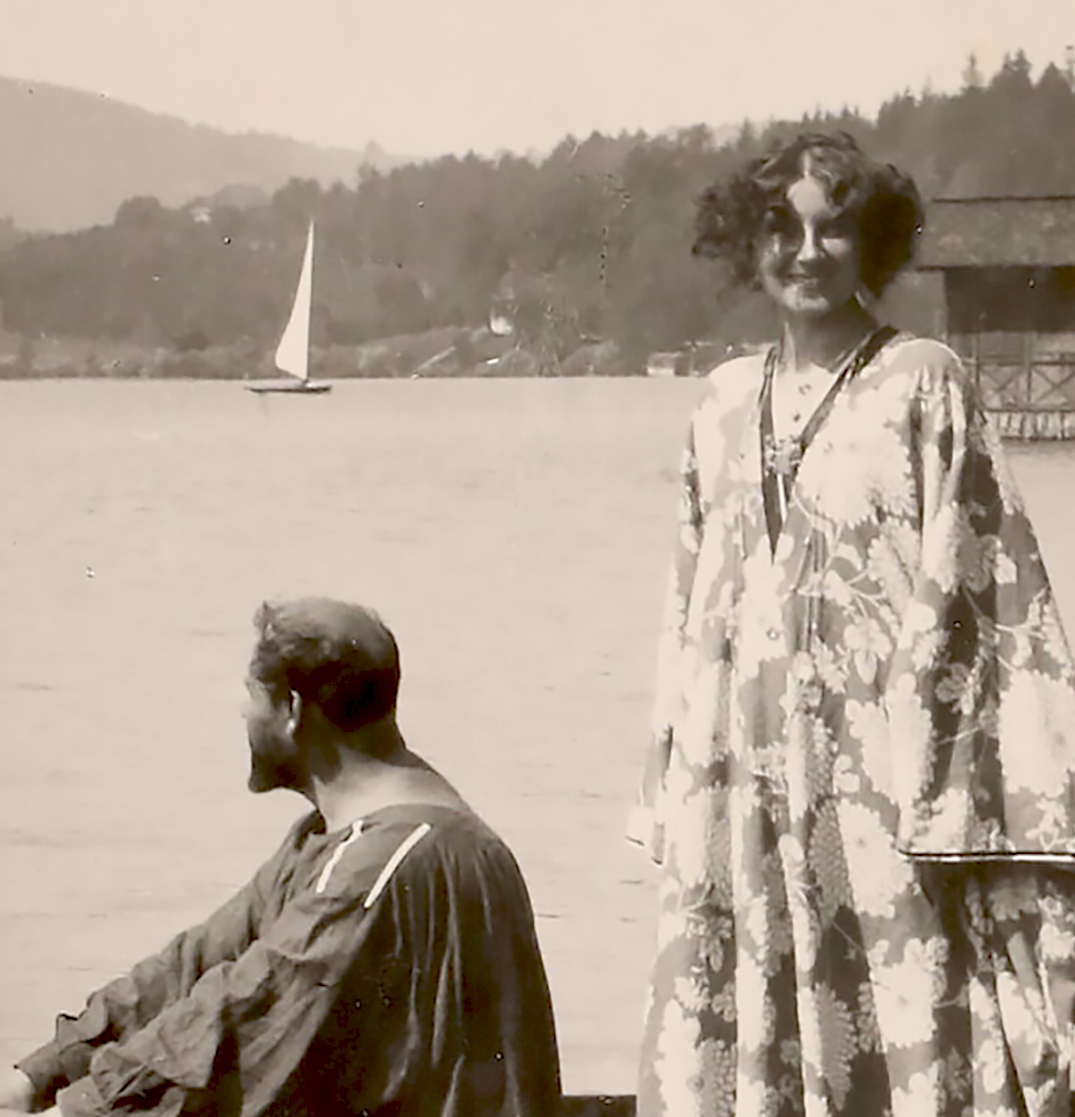
Gustav Klimt
Klimt himself was an enigmatic figure in fin-de-siècle Vienna. He never married and remained closely attached to his mother throughout her life, while rumours surrounded his relationships with his models and the wealthy women who commissioned his portraits. Although photographs often show him looking rather stern and distant in the long painter’s smock that became almost his trademark, his private life was considerably more complicated, and he was reputed to have fathered numerous children with his models.
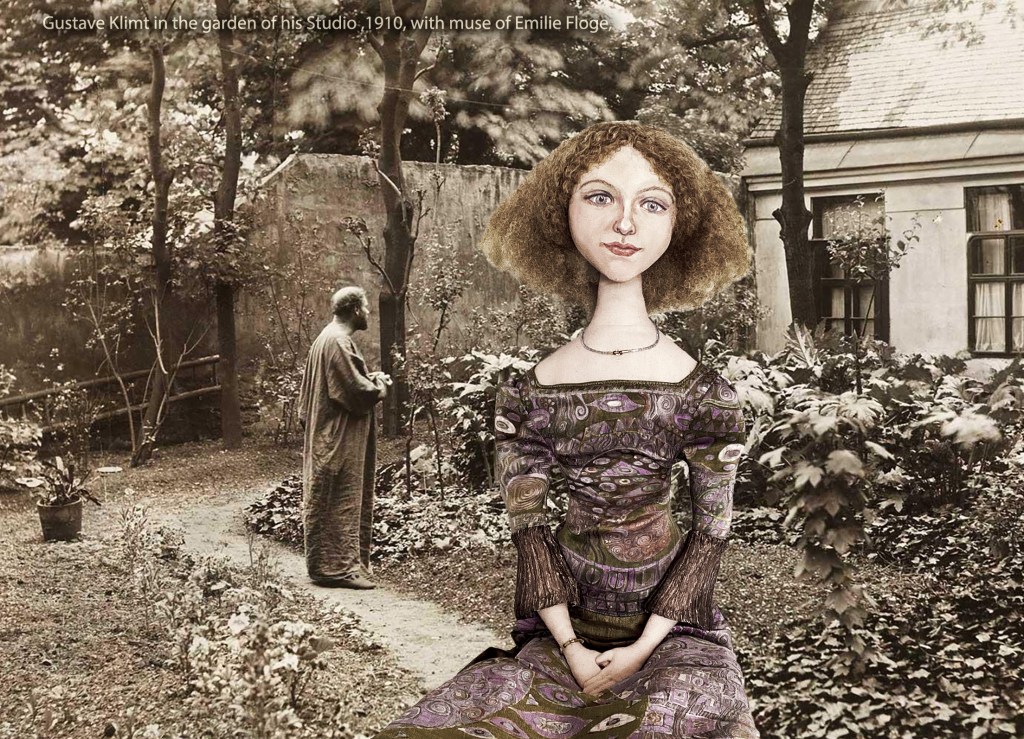
Gustav Klimt in garden of his Studio 1910, with muse of Emilie Flöge.
Against this backdrop, his lifelong bond with Emilie Flöge remains something of a mystery. Their correspondence, discovered decades after Klimt’s death did little to clarify the nature of their relationship. Much of it consists of ordinary, everyday matters rather than declarations of affection. And yet, taken together, the letters reveal the continuity of a relationship that endured for decades. Whatever the nature of their relationship, Emilie’s own life was developing alongside it.
Emilie The Designer
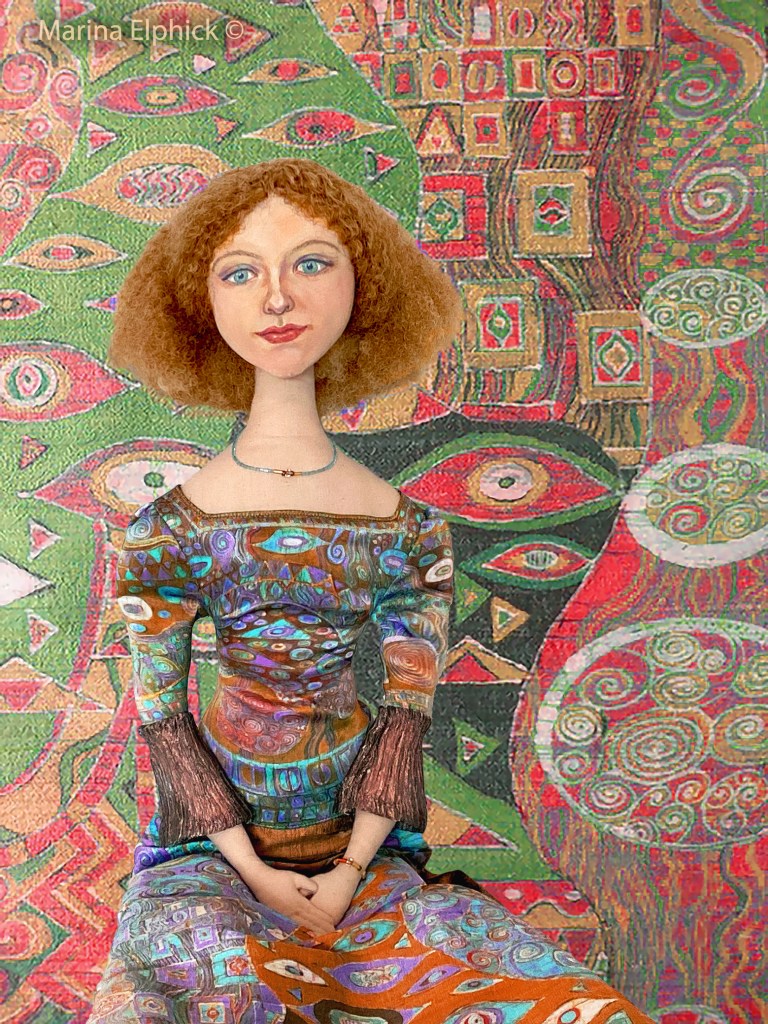

Emilie Flöge muse with batik design on silk,by Marina. Portrait of Emilie by Gustav Klimt 1902, cropped.
In 1904, Emilie joined her sisters Pauline and Helene in establishing the Schwestern Flöge fashion salon on Vienna’s Mariahilfer Straße. The salon quickly became one of the most fashionable addresses in Vienna. Its striking Jugendstil interiors reflected the artistic world of the Wiener Werkstätte, with designers and artists including Josef Hoffmann and Kolo Moser contributing to its distinctive aesthetic.
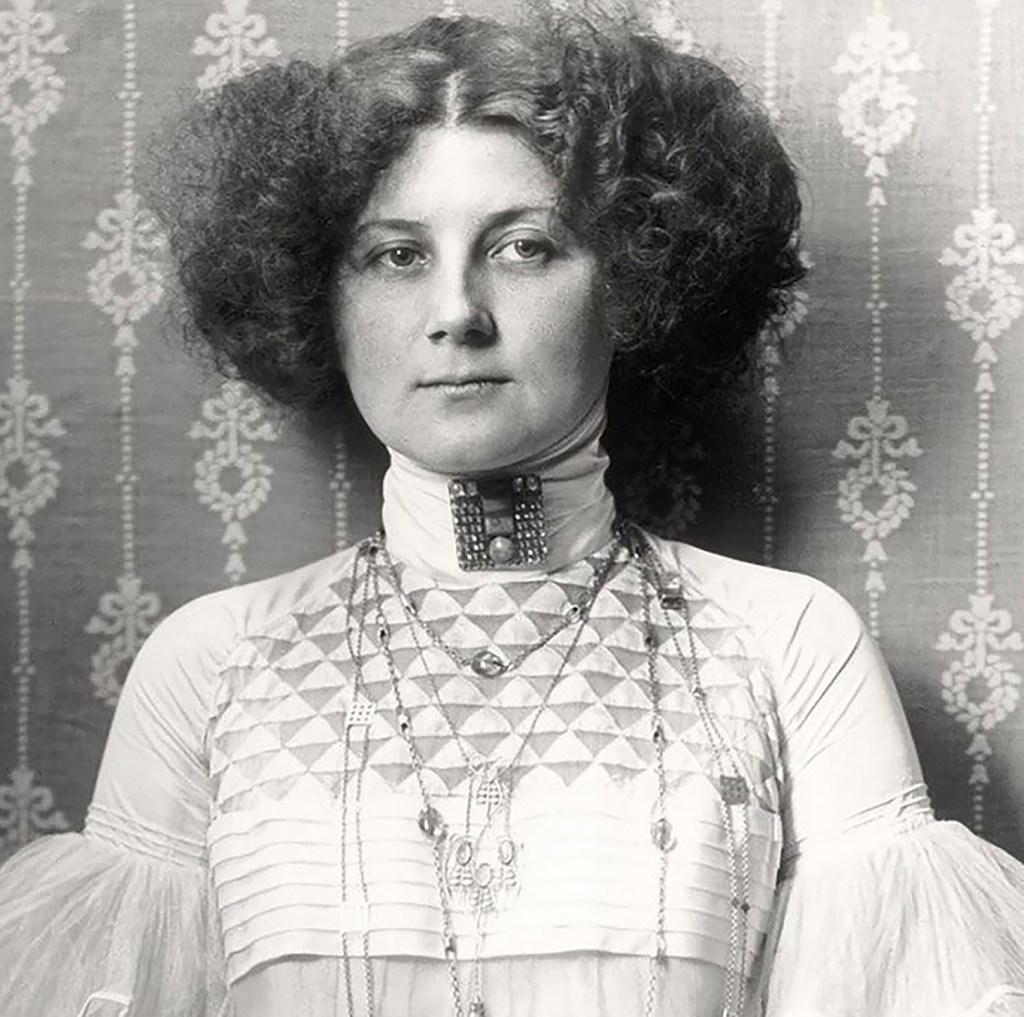

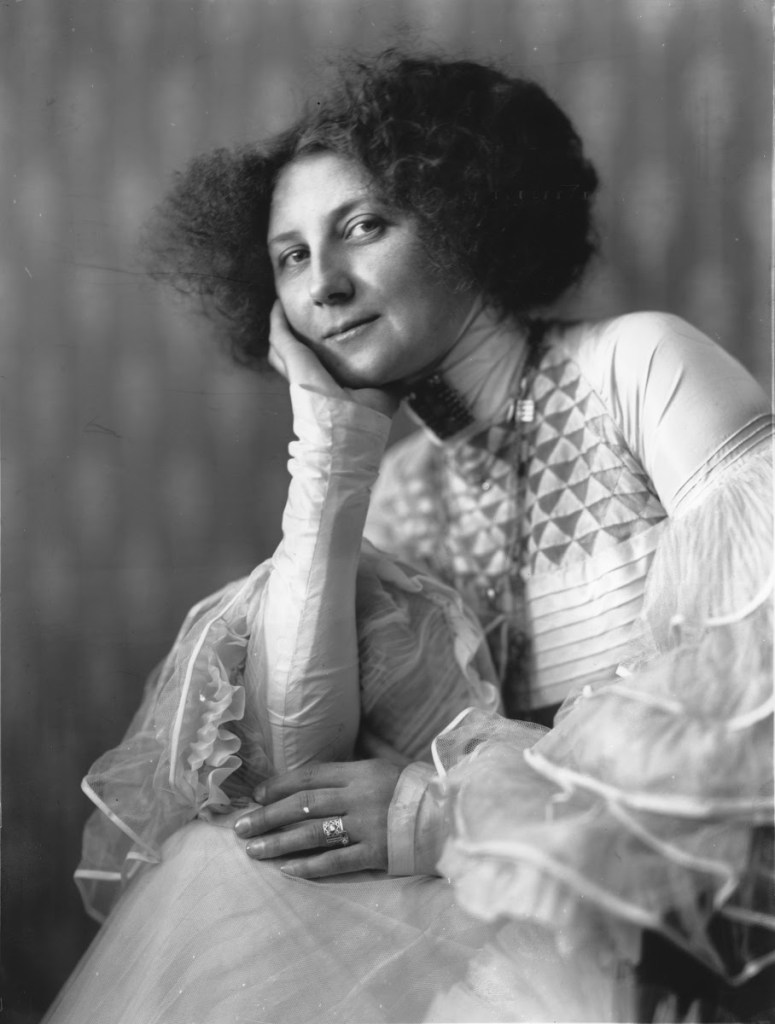
Emilie was the driving creative force behind the salon. She travelled to Paris and London to keep up with new fashions, fabrics and ideas, bringing contemporary influences back to Vienna. She became particularly associated with the emerging dress-reform movement, favouring looser, more comfortable garments that challenged the restrictive corseted fashions traditionally worn by women. Her designs offered women greater freedom of movement and a new relationship between the body and clothing.
Her approach to fashion was also quietly radical for its time. By challenging the restrictive corseted silhouette, Emilie was part of a growing movement towards greater freedom and independence for women. Her designs allowed the body to move more naturally and gave women the opportunity to express themselves beyond the conventions of traditional dress. In this sense, there was a distinctly feminist spirit in her work; she was not simply designing clothes, but helping to imagine a different way for women to inhabit their bodies and present themselves to the world.
It is easy, looking at Klimt’s paintings, to see Emilie’s influence reflected in the extraordinary textiles, patterns and flowing garments that surround his female figures. Their artistic worlds overlapped, sharing an appreciation of pattern, colour, ornament and the expressive possibilities of clothing. Emilie designed clothing for Klimt, and their creative relationship seems to have flowed in both directions.
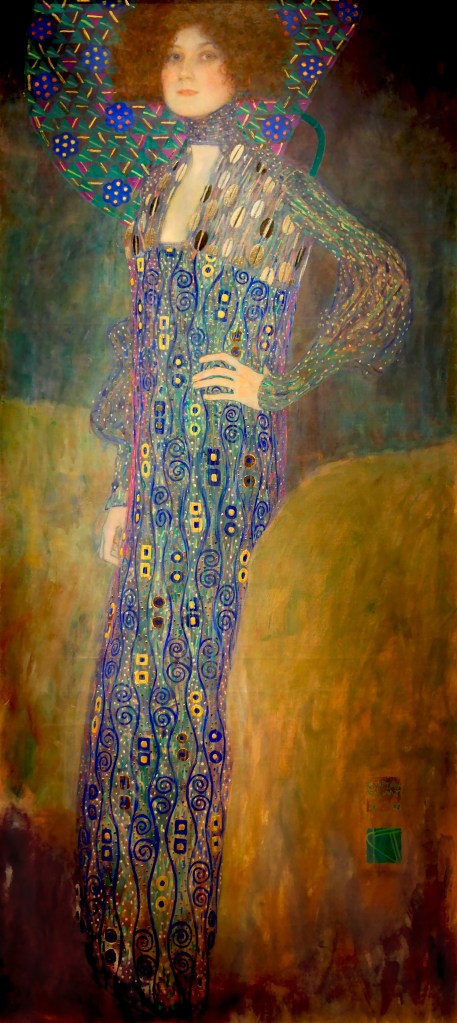
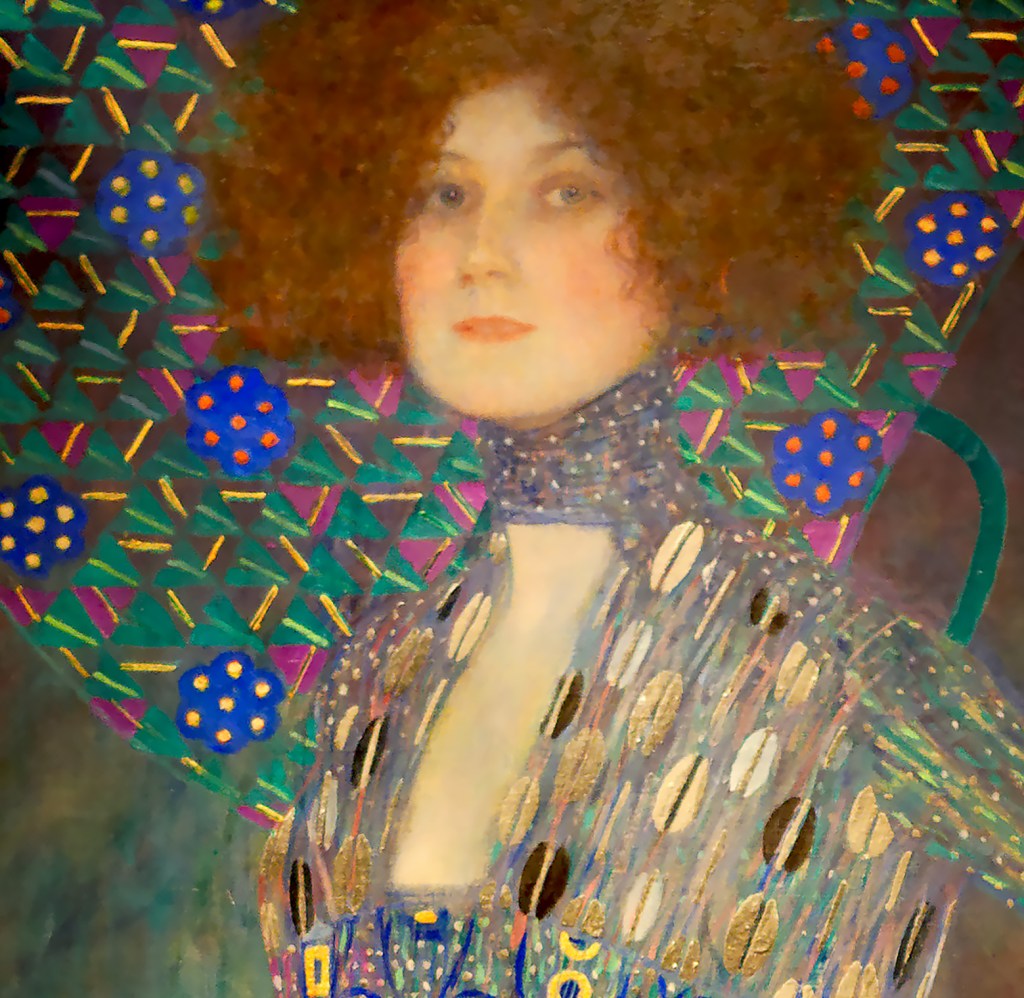
Emilie Flöge, full length portrait by Gustav Klimt, 1902. Emilie Flöge, portrait detail by Gustav Klimt 1902.
Klimt painted Emilie several times, but his best-known portrait of her was begun in 1902 and completed several years later. She stands almost life-size against an elaborate decorative background, wrapped in a richly patterned garment. Her elongated figure, composed expression and striking costume create an image that is unmistakably Klimt, yet there is something intriguing about Emilie herself. She appears self-possessed rather than simply decorative… a woman who seems to occupy the painting on her own terms.
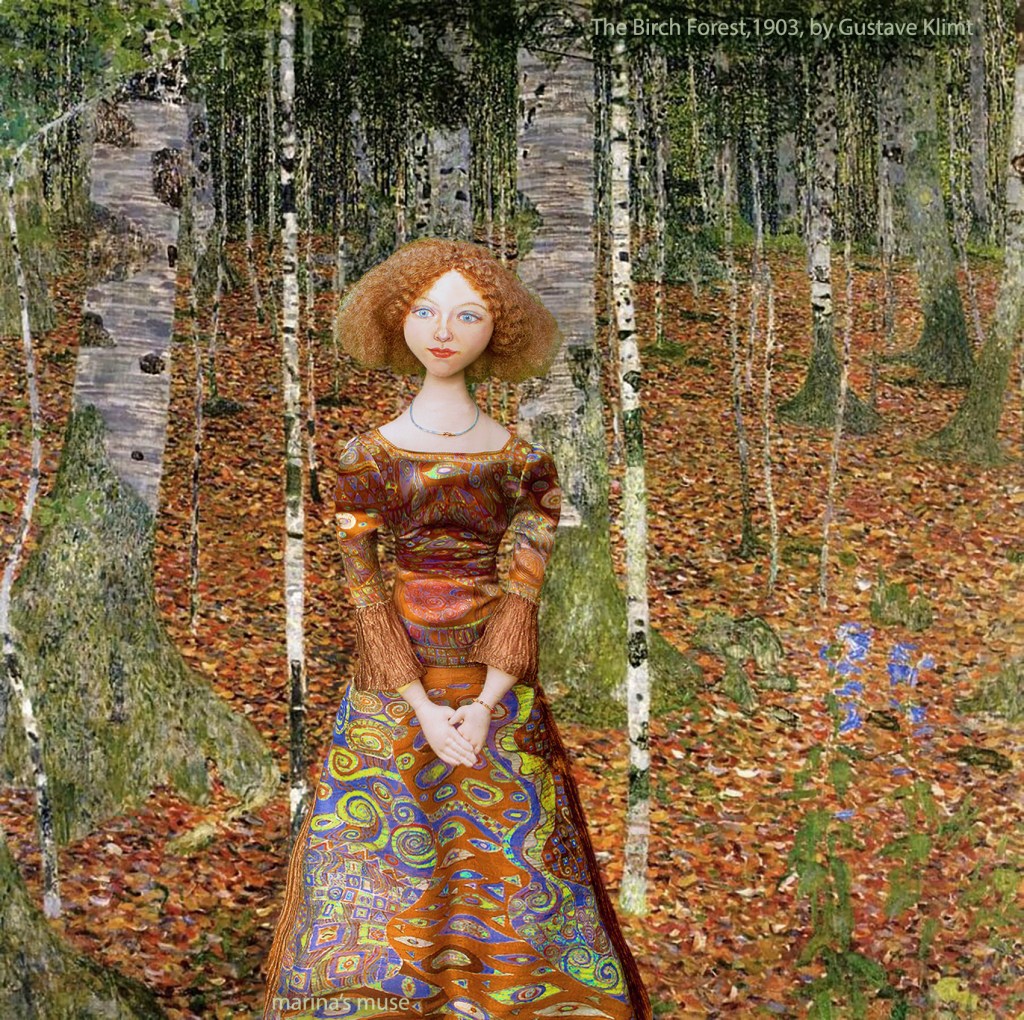
Muse of Emilie in the painting ‘Birch Forest’, 1903, Gustav Klimt.
Sadly in February 1918, aged 55, Gustav Klimt suffered a stroke that required hospitalisation.
While in hospital, he died from pneumonia brought about by an early case of the Spanish flu.
In the 1930s, Emilie was an established and respected businesswoman, but the political upheaval that followed the Anschluss in 1938 brought an abrupt end to the world she had built. Her salon lost many of its most important customers and she was eventually forced to close the business.
She continued to work privately from the top floor of her home, but the elegant world of Schwestern Flöge had disappeared.
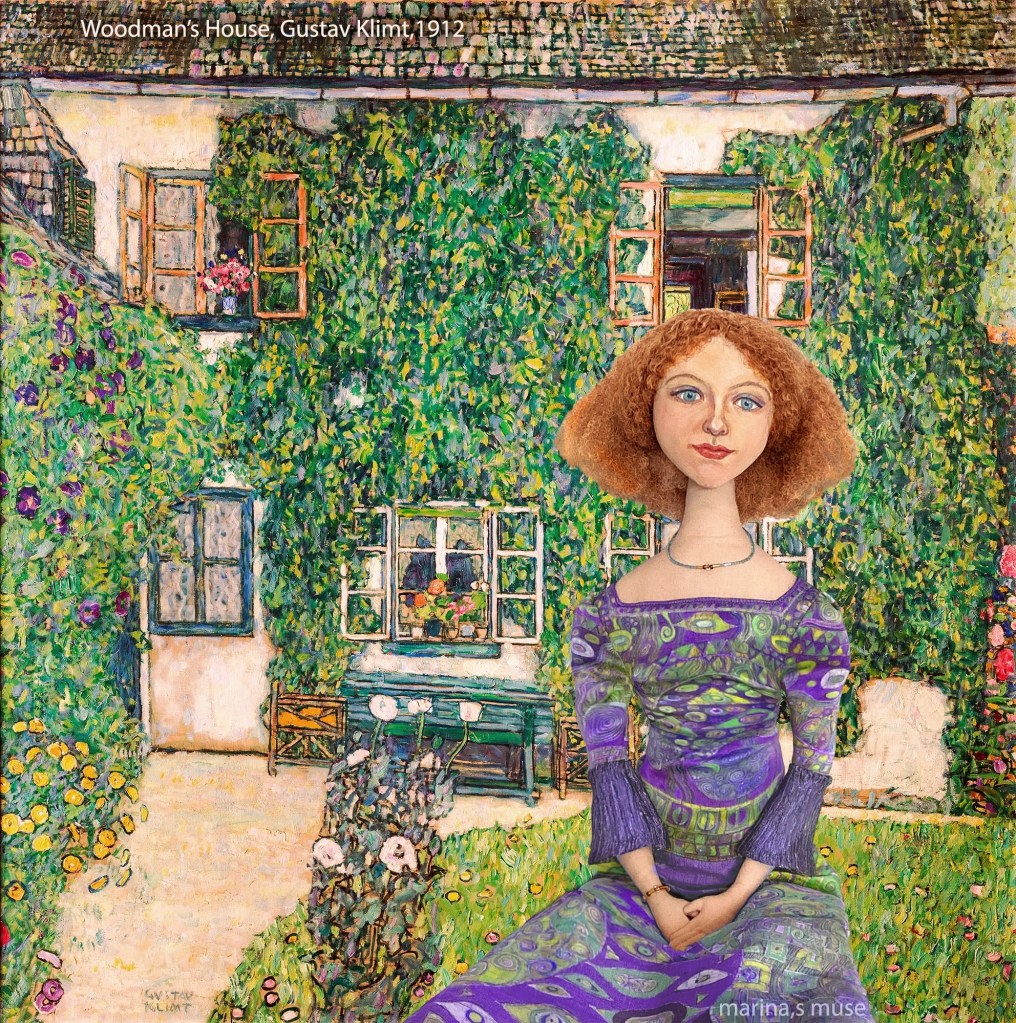
Emilie Flöge muse imagined seated by ‘Woodman’s House’, painted by Gustav Klimt.
During the final days of the Second World War, a fire destroyed much of what remained in her home, including her collection of clothing and objects associated with Klimt.
Emilie lived on in Vienna until her death in 1952, she was 77.
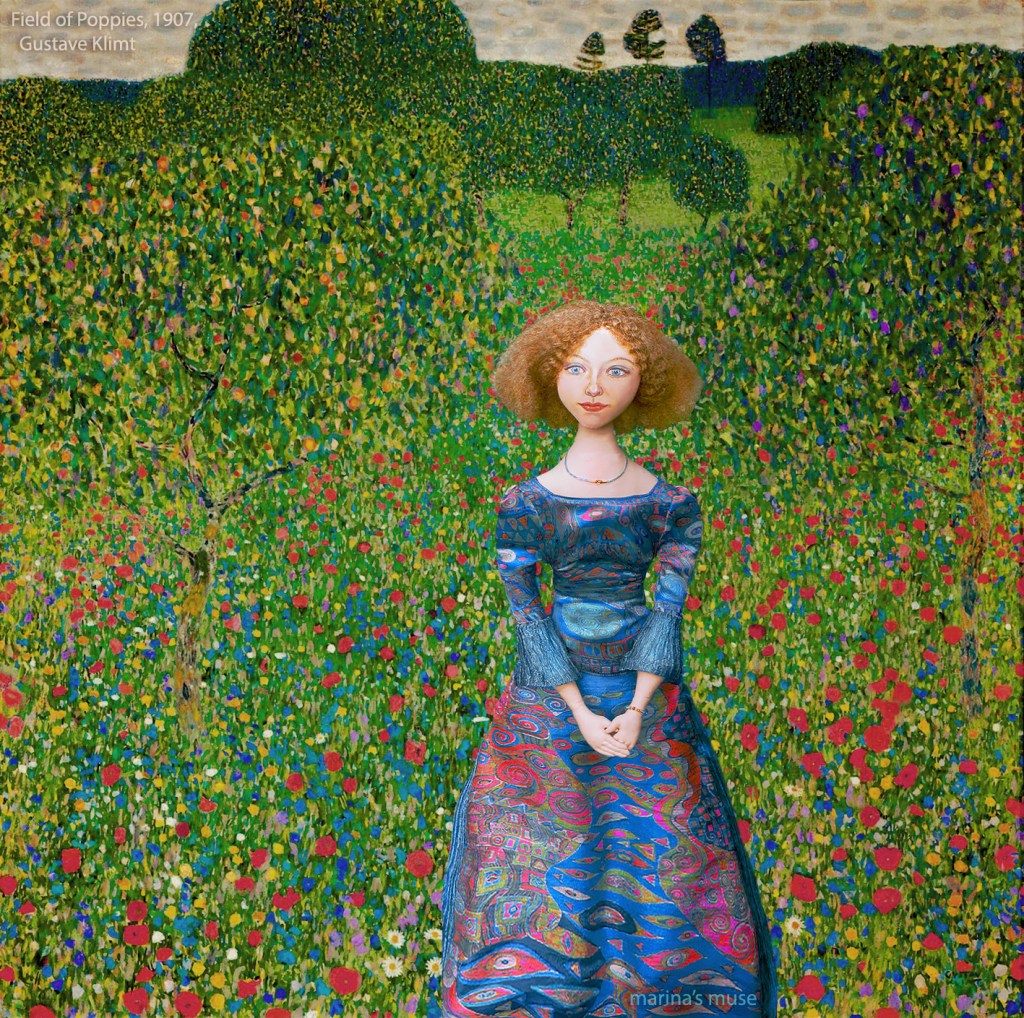

Emilie muse in, ‘Field of Poppies’, 1907, Gustav Klimt. Muse in ‘Country Garden’, detail, by Gustav Klimt.
Emilie Flöge was not simply Klimt’s muse. She was a woman who created her own visual language… a contemporary designer and businesswoman who, in her own way, helped shape the extraordinary world of Viennese modernism.
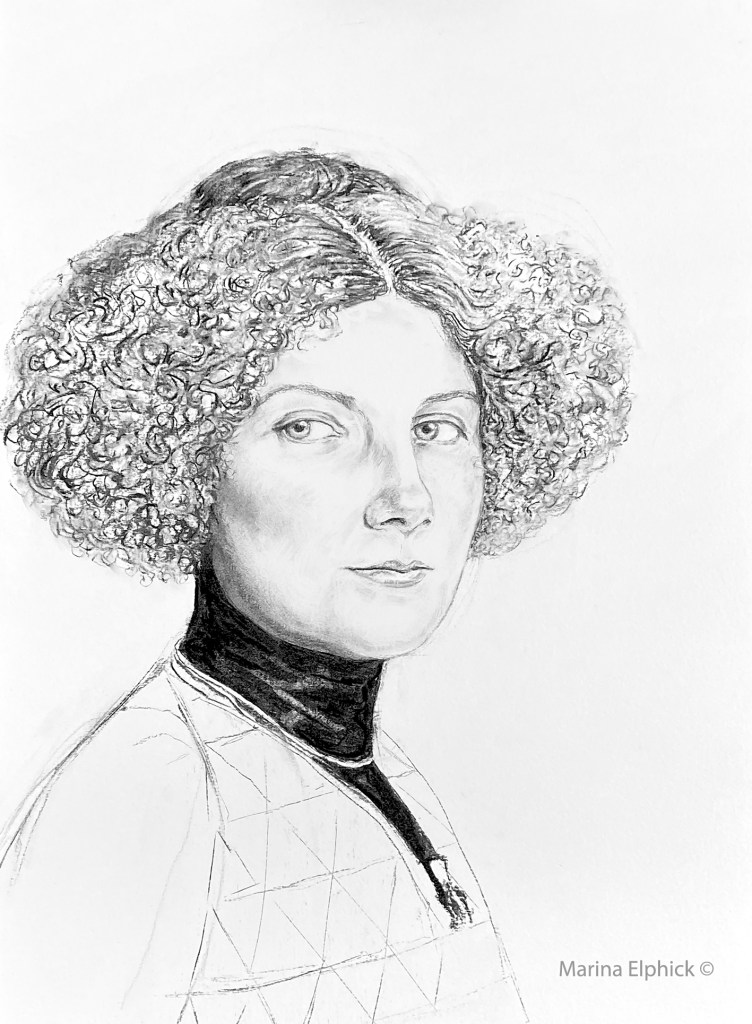
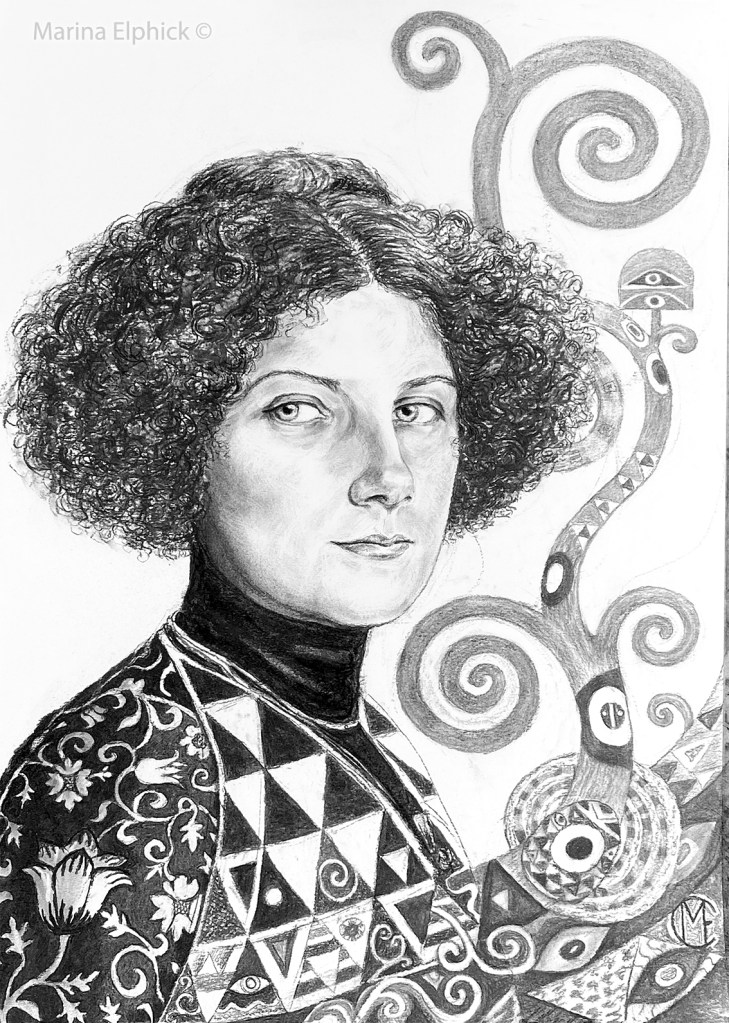
Emilie Flöge, Charcoal on paper, by Marina Elphick.
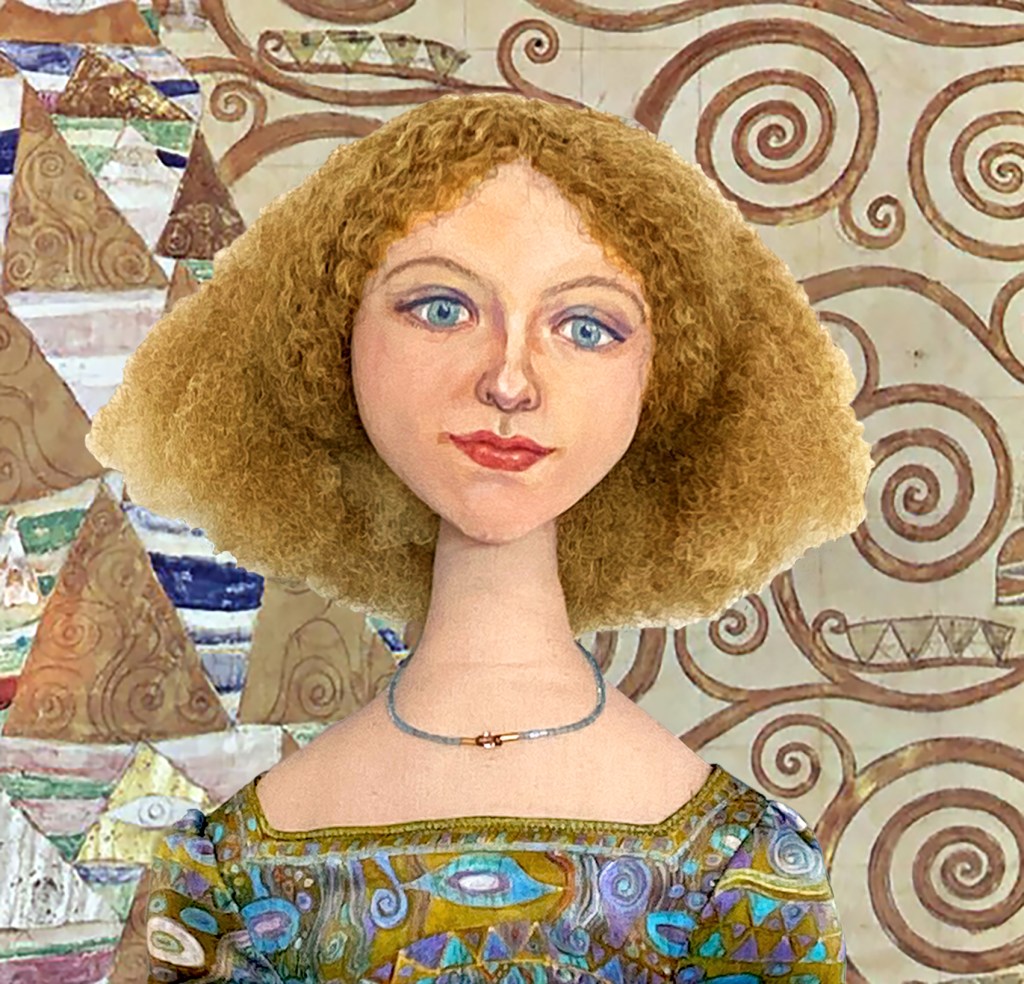
Emilie Flöge muse portrait set in front of a detail from, ‘Expectancy’ 1905 by Gustav Klimt.
In creating my Emilie muse, I wanted to look beyond the familiar image of the elegant woman in Klimt’s portrait and celebrate the person behind it. Her love of textiles and pattern naturally drew me to her, and as I worked with fabric, dye and stitch, I began to feel a connection between her creative world and my own. Through the process of making, Emilie gradually emerged in another form — not simply as Klimt’s subject, but as a woman whose own creativity and individuality could be expressed through cloth.
For me, Emilie Flöge is a reminder that the women who appear within art can have stories, ambitions and creative lives of their own.
It is this hidden dimension of the muse that continues to intrigue me.
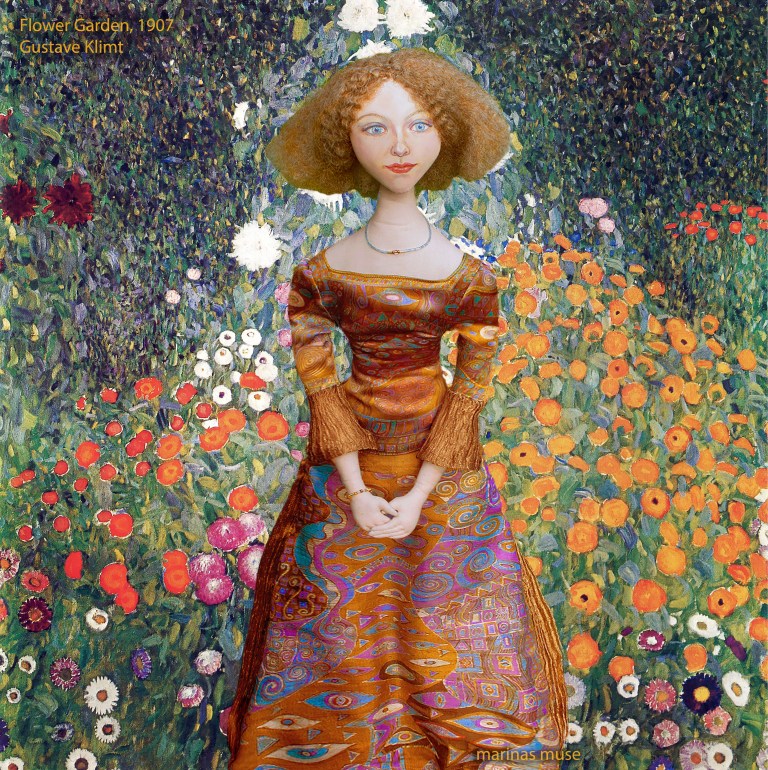

Emilie muse by Lake Garda in a painting by Gustav Klimt. Emile Flöge muse in Klimt’s flower garden, painted in 1907.
Acknowledgements
Gustav Klimt Women, George Wiedenfeld & Nicolson, 1986.
Byron’s Muse https://byronsmuse.wordpress.com/tag/emilie-floge/
The collector https://www.thecollector.com/gustav-klimt-muse-emilie-floge/
Threads https://www.threadsmagazine.com/2021/03/09/profiles-in-sewing-part-2-emilie-floge
Tanisknits https://www.tanisknits.com/tanisknits-1/2017/09/21/emilie-floge


What a beautiful and inspiring story. Emilie Flöge was much more than a muse; she was a talented, independent, and creative woman. I really love the connection between art, fashion, and textiles in her story. Thank you for sharing this wonderful work! ❤️
LikeLiked by 2 people
I have always admired Klimt’s work because of the so much detail and emphasis on texture in his paintings instead of the usual light and shading. I am a textile designer and now I see why it is so fascinating for me and the story of the muse behind his paintings and his style. Thank you for sharing this. This is a gem of blogpost.
LikeLike
This is incredible! 🌚☄️❤️💫
LikeLike
So beautiful
LikeLike
Beautiful and the history is always fascinating.
LikeLiked by 2 people
So beautiful
LikeLike
Your work is amazing!
LikeLiked by 2 people
There’s something so meaningful about the way you frame this, Emilie wasn’t just observed by Klimt, she shaped the visual world he painted in, through her own designs and taste. Your doll capturing that dual identity, muse and creator both, is a lovely way to honor her.
LikeLiked by 2 people
👍👍
LikeLike
Your handmade Emilie doll with the batik silk is absolutely stunning, Marina! Recreating a designer who was so passionate about fabric through your own textile work is such a fitting tribute. Seeing her set against Klimt’s background brings her story to life in such a unique way! 🎨🧵
LikeLiked by 2 people
First of all we have to say that we very much like the pictures of Emilie Flöge by Klimt – although we are not Klimt-fans at all.
We didn’t know about this exceptional lady. Thanks for introducing us to her.
The Fab Four of Cley
LikeLiked by 1 person
I love your artwork and writing about these incredible muses. You are such a talented artist. I am an older woman trying to learn how to draw and paint and make films and find your lovely little artistic stories just beautiful.
LikeLiked by 3 people
Thanks for your incredible artwork and the stories of the artists and muses. You are so talented.
LikeLiked by 4 people
You are so talented. I love hearing about the muses and seeing the beautiful artwork you make. I am trying to learn to paint and draw and make films as a 59 year old woman. I find your stories about the muses and artists incredibly inspiring.
LikeLiked by 3 people
As always Marina, your ‘Muse’ stories continue to fascinate me and I love the dolls which must take hours of work. Brilliant! Xx. Ali
LikeLiked by 3 people
amazing woman and designer. I saw her work and photos in Vienna recently . Your doll is beautiful.
LikeLiked by 3 people